ABOUT MEETINGS, CONVENTIONS, BOOKS AND JOURNALS – Review by Michel PERRIN
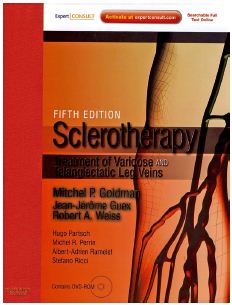
Sclerotherapy. Treatment of Varicose and Telangiectatic Leg Veins.
Goldman MP, Guex JJ, Weiss RA (eds) 5th edition. Saunders Elsevier. 2011.
ISBN – 13: 9780323073677

First published in 1991, and republished in 1995, 2001, 2007, this book remains the backbone of our knowledge concerning sclerotherapy of chronic venous disorders. Divided into 15 chapters plus 8 appendices, this reference work of 401 pages covers not only sclerotherapy, but also anatomy (Stefano Ricci), surgery (Michel Perrin) and intravascular procedures (radiofrequency and lasers) for treating varicose veins, the use of compression (Hugo Partsch), venoactive drugs (Albert-Adrien Ramelet), and laser and high-density pulsed light treatment of telangectasias.
I particularly appreciated the chapter on noninvasive investigations before sclerotherapy (35 pages including 182 references).
The chapters on sclerotherapy itself (7, 8, 9, 12, 13) provide all the details that beginners and the experienced phlebologists alike need to know. At the end of the various treatment chapters, the reader will find several case histories with outstanding illustrations that are crucial to understanding the clinical course throughout treatment, from pre-interventional status to the final result. The last chapter (15) provides very practical and useful recommendations on how to set up a sclerotherapy practice.
The 8 appendices, which are only available online (www.expertconsult.com) are instructive and practical. They give information on compression, manufacturers and distributors of sclerosing solutions, equipment sources, patient brochures, answers to questions frequently asked in the postoperative period, what to tell a patient presenting with a varicose hemorrhage, a checklist of questions for your secretary to ask a patient on the telephone before making an appointment, and a coding and billing guide for endovenous laser ablation. Of course, some of this information is specific to the USA.
More than 2800 references are quoted, including 612 on sclerotherapy complications and how to avoid them. Over 500 figures, most of them new and in color, illustrate the book and facilitate understanding of the anatomy, physiology, and pathophysiology, and of the technical details recommended by the authors.
The DVD-ROM supplied with the book is particularly appealing and easy to use.
Without a doubt, if you perform sclerotherapy you should acquire this book for your library, and more importantly you should read it.